The question behind the idea
Personal device setups rarely match a generic accessory perfectly. A case changes the fit, a cable connector needs clearance and the preferred viewing position depends on the desk. Reading about a custom desk console suggested a smaller question: how much of that personal fit could be addressed by one simple passive object?
Let the cable help define the shape
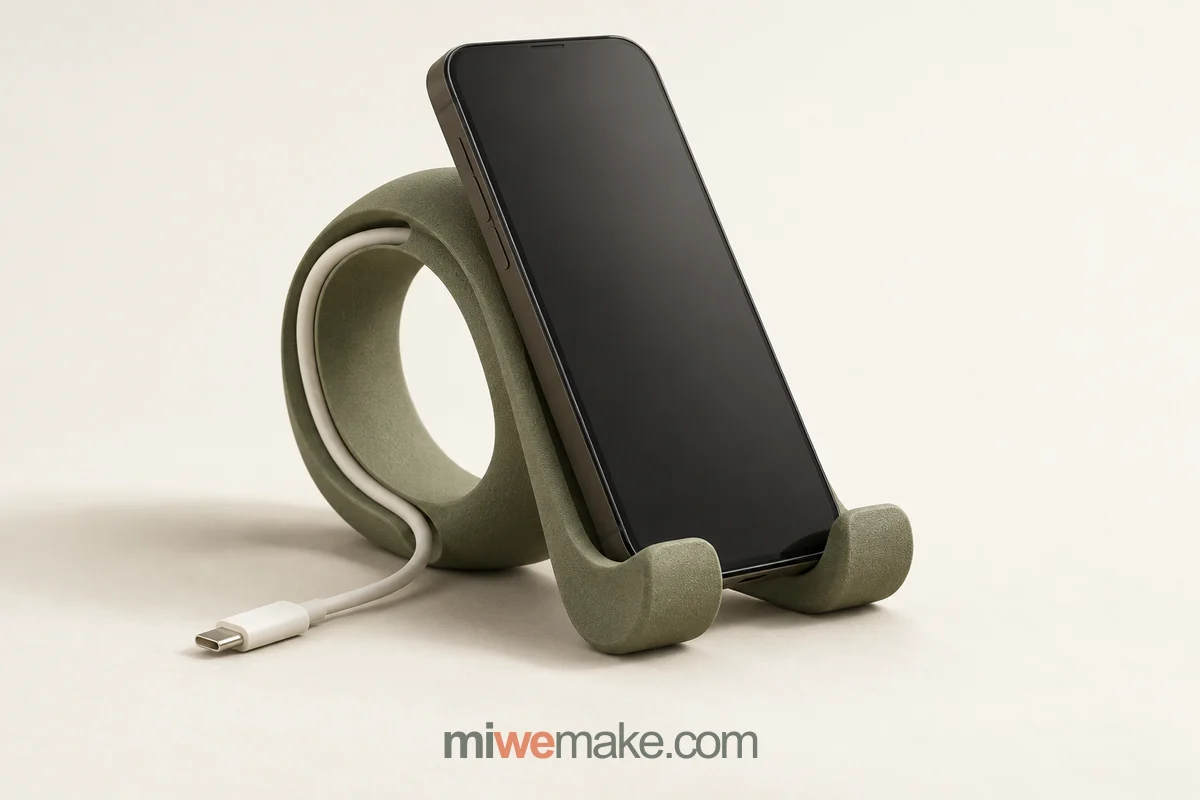
The concept uses a broad olive loop as a back support, with two rounded front feet and an open path for a cable. The opening keeps the object visually light and gives the lead a deliberate direction. There is no charging system built into the stand. The phone and cable are context for the design rather than electronic components supplied with it.
What could make it fit a particular user
The phone and case dimensions, portrait or landscape use, connector size and viewing angle could all change the form. The loop could become more compact, the front lip could be adjusted or the cable channel could move to the other side. A physical mock-up would help test those decisions before appearance details are finalised.
A possible manufacturing direction
A polymer printing route could be considered for early fit studies and the curved form, with process and material selected around stiffness, surface condition and intended use. The pictured texture is a visual direction, not a material test. Wall thickness, build orientation, support access and finishing need to be reviewed against an actual model.
What a first brief would need
Share the device and case dimensions, the cable and connector, the preferred viewing position and how the stand will be used. Identify the contact surfaces and the appearance you want. The first engineering questions concern stability, tipping, cable access and protection of the device. Prototype checks would establish fit, stability and practical cable access before manufacture.