Give the empty space a role
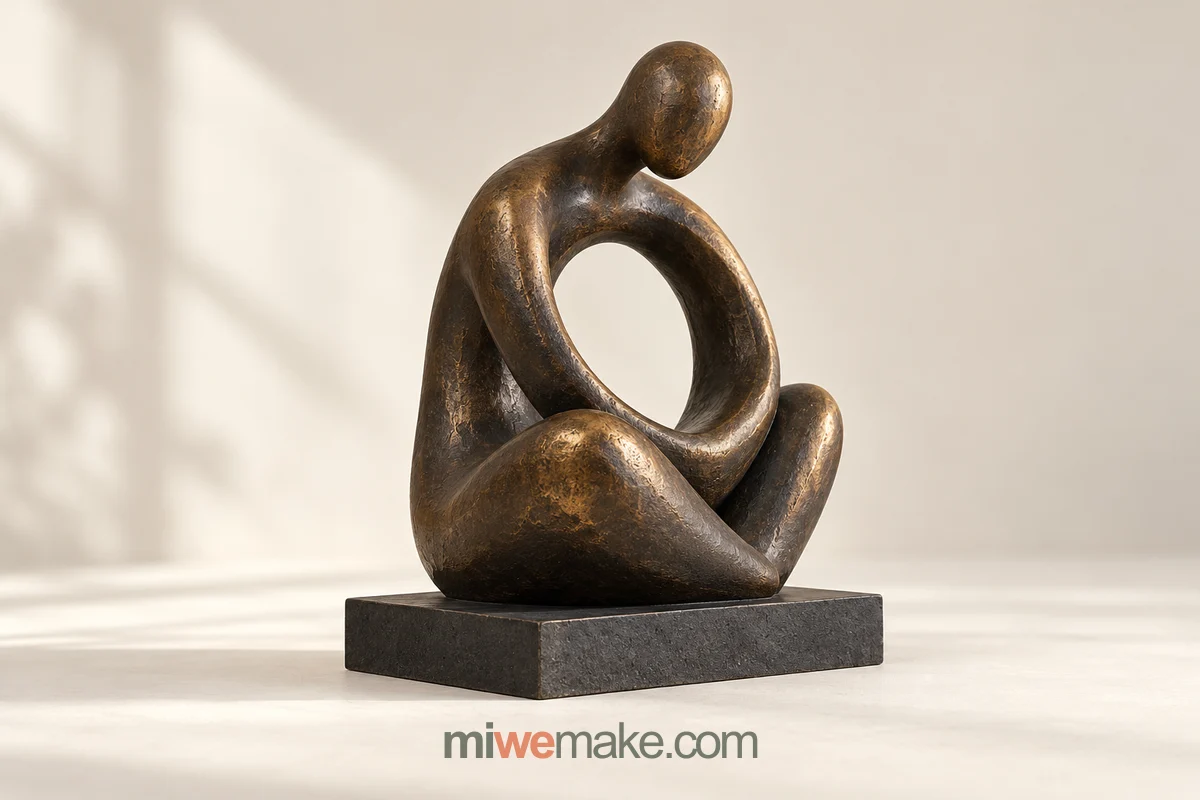
The starting question is how little detail a figure needs before its posture becomes expressive. Here, the head inclines towards the space framed by the arms, and the folded legs lead the eye back towards that opening. The concept is intended as an original contemporary display piece for a shelf, reception counter or interior setting, where its silhouette can be read from more than one direction.
Let the surface support the form
A dark bronze-coloured surface picks up warmer highlights on the shoulders, knees and edges of the opening. The low charcoal plinth gives the curved figure a more architectural base. Keeping the face smooth and featureless leaves the emphasis on proportion, texture and the relationship between solid material and the open centre. The image explores a surface appearance; it does not establish the sculpture's material or weight.
Develop a particular edition
The opening could become taller or narrower, the head could turn slightly, and the base could change to suit a display position. Scale would affect the thickness of the neck, arms and other connections, as well as how the object is handled. A useful brief could define a quiet single-finish version or a more pronounced surface contrast, then compare a physical model under the lighting where it will be displayed.
Begin with a model and a finish sample
A digital sculpt and a printed maquette could establish the silhouette before the production method is chosen. Build orientation, support access inside the opening, section joins and the connection to the plinth would all need planning. The bronze appearance could be explored through an agreed finish sample on a printed model; a solid metal edition would require a different production plan. Final dimensions and handling requirements would determine which route is practical.
What to include in the first brief
Share the intended display setting, overall height, principal viewing angles and an original sketch or sculpt file. Identify which proportions must stay fixed and provide a finish reference, quantity and destination. The review would include balance, base attachment, accessible finishing areas and a packaging method that supports the figure without loading its narrower connections. An early physical sample would help resolve those choices before an edition is produced.